Light-activated treatment that targets bacteria within dental biofilm. No antibiotic exposure and no known mechanism for bacterial resistance — designed for repeatable biofilm control.
8+ Years of Clinical Research
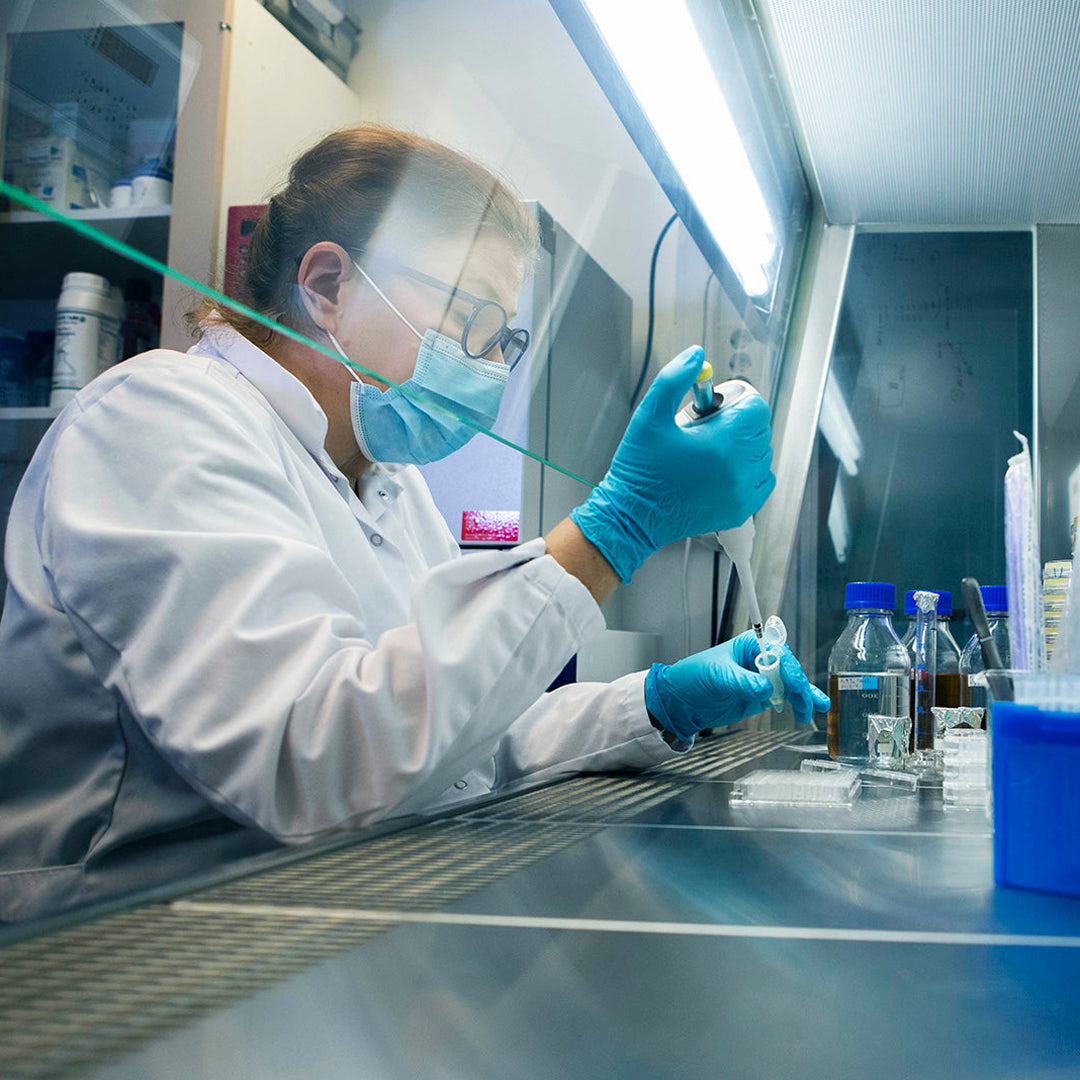
Built on years of laboratory development, randomized clinical trials and academic research. The science behind Lumoral began long before the treatment reached everyday clinical use.
MDR-compliant medical device
Lumoral is a CE-marked Class IIa medical device developed under the requirements of the EU Medical Device Regulation. Medical technology, with the clinical evidence, safety and quality requirements that come with it.
Professional care doesn't have to end when the patient leaves the clinic.
We believe a continuous biological challenge requires a continuous management strategy. When mechanical biofilm control is being performed but the clinical response remains insufficient, the clinic should not have to wait until the next appointment to influence what happens.
Continuous Biofilm Control with Lumoral adds another layer between visits: a professionally guided, response-based approach that builds on mechanical home care when individual risk or clinical response indicates that greater control is needed.
The burden of success should not sit on one side of the chair
A patient can leave with clean surfaces, clear instructions and every intention of doing things right, yet return with the same bleeding, plaque or calculus. You know the feeling: the work was done, the patient tried, but the result did not hold.
When that happens, the question should not always be whether the patient needs to try harder. Sometimes the more useful question is whether the current strategy is giving this patient enough control. If the basics are in place and the response is still not where it needs to be, repeating the same appointment and the same advice can only take you so far.
Give home care a treatment layer between visits
Lumoral adds a targeted, repeatable treatment alongside mechanical home care. The patient carries it out at home in ten minutes, while you decide when it is indicated, how it fits the care plan and what response to follow.
Continuous Biofilm Control with Lumoral makes the time between visits an active part of the care plan: something you can influence, reassess and adapt over time, rather than only evaluate at the next appointment.
Continuous Biofilm Control with Lumoral starts with a simple principle: bring the treatment to the biofilm, then activate it there.
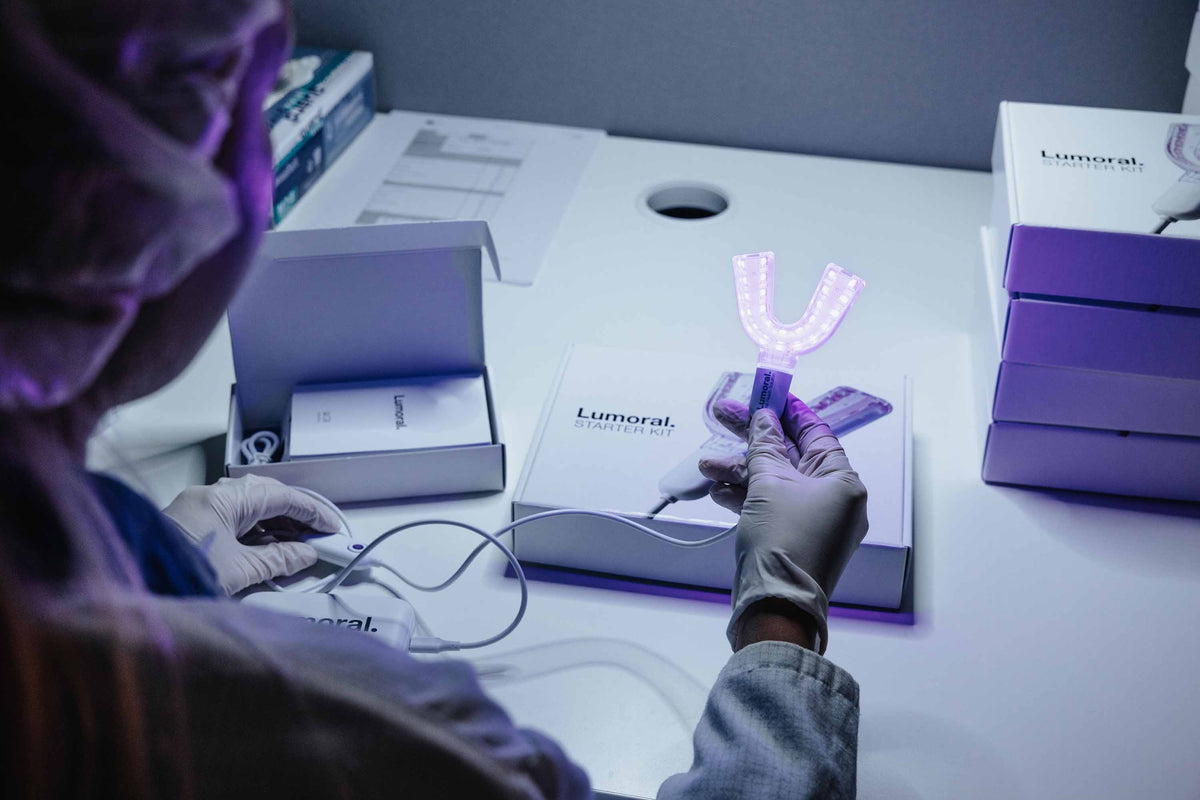
Lumorinse contains a light-sensitive dye that adheres to dental plaque. The Lumoral mouthpiece then activates it with 405 and 810 nm light, combining four complementary actions in one treatment: aPDT, aPTT, antibacterial blue light and photobiomodulation.
The result is a plaque-targeted treatment layer that works alongside mechanical cleaning, while 810 nm photobiomodulation supports the surrounding gingival tissues — all in a treatment that can be repeated at home as part of the professional care plan.
Blue light at 405 nanometers targets specific light-sensitive molecules (porphyrins and flavins) that are naturally present within many harmful oral bacteria. These pigments absorb the light energy, leading to the production of reactive oxygen species (ROS) inside the bacterial cells. This internal oxidative stress damages essential bacterial structures ultimately leading to bacterial death. Because this mechanism depends on intrinsic bacterial components, it does not damage human cells and bacteria cannot develop resistance to it. This makes it an ideal, long-term, drug-free antibacterial strategy.
Photodynamic effect (aPDT)
Photodynamic effect (aPDT)
External Oxidative Attack with Selective Targeting
Indocyanine Green (ICG), a photosensitizing dye, binds selectively to bacterial biofilm. When exposed to red light (810 nm), the dye is activated and produces reactive oxygen species (ROS) in the immediate environment around the bacteria. These ROS rapidly oxidize and damage bacterial membranes and surrounding biofilm structures, leading to their breakdown. This process is selective, sparing beneficial host cells while weakening the protective matrix of mature biofilm and killing pathogens. It creates an external “oxidative burst” that amplifies the antibacterial effect, especially in areas where brushing cannot reach.
Photobiomodulation (PBM) 810 nm
Photobiomodulation (PBM) 810 nm
Mitochondrial Stimulation and Inflammation Reduction
Red light in the 810 nm wavelength range penetrates into tissues and is absorbed by the mitochondria — the energy-producing organelles inside human cells. This light boosts ATP (adenosine triphosphate) production, which fuels cellular repair and regeneration. PBM also reduces pro-inflammatory cytokines and increases circulation in the treated area, helping tissues heal faster and reducing overall inflammation. This is clinically valuable in managing gingivitis, mucositis, and other inflammatory conditions where tissue recovery and stability are critical.
Photothermal effect (aPTT)
Photothermal effect (aPTT)
Biofilm Disruption and Surface Decontamination
When ICG absorbs red light, it not only creates oxidative stress — it also converts part of the light energy into heat. This localized heat (mild, but effective) enhances the breakdown of bacterial cell membranes and weakens the biofilm structure. It also stimulates natural saliva secretion, further helping to flush and clear bacterial debris from the oral cavity. The photothermal effect adds a complementary mechanical and biological cleansing layer, especially effective against stubborn or mature biofilm often found around implant surfaces and in deep periodontal pockets.
Lumoral vs. NSPT alone
5x
fewer non-responder patients
2,2x
more patients achieved healthy gums
1,5x
better biofilm removal
3x
faster inflammation control and improvement of gum pockets
A 6-month randomized controlled trial in 200 periodontal maintenance patients showed that adjunctive home-use dual-light therapy significantly improves inflammation control, plaque reduction, and periodontal stability compared to standard care alone. Lumoral delivers clinically meaningful improvements in periodontal health.
When patients do not move forward, the whole clinic feels it.
Recurring biofilm-related findings do more than frustrate the clinical team. They slow the patient journey.
The hygienist repeats the same guidance. The dentist waits for greater stability before moving to the next stage of care. Chair time is spent revisiting problems that were meant to improve between visits.
That is why the interval matters. When home care produces a better response, patients have a better chance to move forward clinically, without asking the clinic to find more hours in the day.
Continuous Biofilm Control with Lumoral is designed for that gap: helping extend the clinic’s biofilm-control strategy into everyday life, so the work done in the chair has a better chance to carry forward.
Build Continuous Biofilm Control into the care pathway.
In some treatments, the need for stronger biofilm control is predictable. During aligner therapy, implant care, periodontal maintenance or peri-implant maintenance, Continuous Biofilm Control with Lumoral can be built into the plan from the start to help maintain the conditions the treatment depends on.
In other patients, the need becomes clear over time: the motivation is there, the basics are being done, but the clinical response is still not enough.
The same four checks help you decide when Lumoral belongs in the plan, and how to make its use realistic, guided and worth following.
Four checks for guided use
Step 1 — Motivation
Does the patient want the situation to improve?
If the patient does not yet see the problem or want change, start there. Make the risk understandable and the next step realistic before adding another part to the care plan.
Step 2 — Technique
Are the basics really in place?
Check the tools, technique and difficult areas first. Lumoral builds on brushing and interdental cleaning; it should not be used to compensate for basics that have not yet been established.
Step 3 — Routine
Can the plan work in real life?
Some patients know what to do, but the routine does not hold. In these cases, Lumoral may be considered as part of building a clearer home-care rhythm — not as another task added on top of a failing routine, but as a structured treatment moment that can help the patient stay engaged with their oral health.
Step 4 — Response
Are the basics being done, but the clinical result is still not enough?
This is where the need for additional biofilm control becomes clear. When motivation, technique and routine are in place but the response still falls short, Continuous Biofilm Control with Lumoral can add another layer to the plan, with the result followed and the approach adjusted over time.
Good home care starts with the basics. Better control starts with knowing when they are not enough.
When patients feel the difference, the clinic does too.
The right recommendation should make sense to both sides of the chair: why it is needed, what it is meant to achieve, and what happens next.
For the patient, Lumoral creates a clear treatment moment at home. For the hygienist, it offers something more concrete than repeating the same advice. And for the clinic, it gives the care plan a way to continue between visits.
When Continuous Biofilm Control with Lumoral is introduced as part of the plan — alongside brushing, interdental cleaning and professional care — the patient knows why they are doing it, and the professional has something meaningful to follow at the next visit.
Across the six-month trial, patients using Lumoral alongside standard care had roughly a third fewer bleeding sites at recall than standard care alone.
Shallower pockets, fewer deep sites
Deep pockets (≥4mm) were reduced by about a third compared with standard care alone, over the same trial.
Biofilm brought under control
Visible plaque coverage at six months was cut by close to a third compared with standard care alone.
Less calculus formation over time
Long-term use (12+ months) has been linked to reduced plaque and calculus buildup in extended-use studies — a slower, cumulative benefit rather than a six-month trial finding.
Relevant beyond periodontal maintenance
A pilot study in peri-implant disease recorded reductions in plaque burden, inflammation, and aMMP-8 with regular use — relevant specifically to peri-implant maintenance.
Comfort alongside the antibacterial effect
Some patients report reduced dry mouth alongside biofilm control — relevant wherever dryness itself makes self-care harder.
Prof. Dr. med. dent. Werner Birglechner, dentist
The clinical evidence is truly compelling. In particular, personalized risk profile-based guidance from a dental hygienist offers enormous potential for targeted treatment free of side effects. Lumoral will significantly improve the treatment of periodontal disease in particular, with long-lasting effects.
Pekka Kallio, Dental Specialist
Today I saw once again the benefits of using Lumoral for an implant patient I was treating. He had been using the device daily for two weeks. A completely clean and healthy mouth.
Akke Kumlien, dentist, Södertandläkarna, Stockholm
We work with dental implants and complex dental care, and we have been using Lumoral for quite some time to reduce oral inflammation and improve the results of our treatments. Our patients notice a clear difference after just a few weeks of use. That is why we recommend Lumoral® to our patients.
Aliisa Heinonen, dental hygienist
I am absolutely speechless! It is amazing to see the results in a real patient’s mouth. The patient’s gums are like new, and gum bleeding has decreased from 25% to 2% in a 3-month check-up. All 4 mm pockets have disappeared.
Be among the professionals changing what happens between appointments.
Whether your interest is clinical use, research, education, distribution or practice development, we would be happy to discuss how Lumoral could fit your work.
The collaboration unites ABOC’s scientific heritage in osseointegration with Koite Health’s light-activated Lumoral® technology to advance the evidence base for protecting peri-implant health across the full implant journey. Koite Health, the Finnish oral-health technology company behind Lumoral®, and the Associated...
The collaboration combines Unident’s Nordic professional reach with Koite Health’s Lumoral technology to improve access to preventive, clinic-led oral care. Helsinki, 11.6.2026 — Koite Health, the Finnish oral-health technology company behind Lumoral, and Unident, one of the Nordic region’s leading dental...
Yes — and it's not a single study. The lead trial, HOPE-CP, is a six-month randomised controlled trial in 200 patients already in periodontal maintenance care, published in the Journal of Periodontology. Alongside standard care, it recorded more than twice as many patients reaching healthy gum status, with measurable reductions in bleeding on probing, visible plaque, pocket depth, and aMMP-8, an enzymatic marker of periodontal tissue breakdown. That trial sits alongside a wider body of published and peer-reviewed work — including a peri-implant disease pilot and several university theses — each with its own patient group and design stated plainly, not folded into one broad claim. The full picture, including where the evidence is strongest and where it's still growing, is on the evidence page.
Lumoral works in studies, but does it work with real patients?
Fair question. The trials show a real clinical basis, but the actual decision at the clinic is still entirely yours — who fits, based on motivation, guided self-care, and a response that stays insufficient despite both. Nothing here is left to hope; a rhythm and a follow-up point get agreed from the start.
If the patient does not use an interdental brush, why would they use Lumoral?
If motivation or the basic routine is missing, Lumoral is usually not the first solution. First find out whether motivation, capability or everyday opportunity is missing. Lumoral is strongest in a patient who is already trying, but whose response is not sufficient. This is a different patient from one who does not yet experience the problem as their own.
How does this differ from chlorhexidine or other antimicrobial methods?
It's not positioned as a replacement for any of them — the goal was never to pick a winner between antimicrobial approaches.
Chlorhexidine is typically a short course, for a specific period; Lumoral is built for daily or regular use over the long term, without the staining, taste disturbance, or resistance concerns that come with extended antiseptic use. In practice, the two can sit alongside each other rather than compete — chlorhexidine for its usual short-term role, Lumoral for the ongoing, at-home layer in between. The right combination, like everything else here, stays a clinical decision made case by case.
Which diagnoses is Lumoral suitable for?
A diagnosis or symptom opens consideration, but does not alone determine the recommendation. Lumoral may be considered in biofilm-related problems such as gingivitis, periodontal maintenance care, peri-implant tissue challenges, abundant calculus formation, halitosis and high caries risk. The recommendation is made only after the four questions: motivation, capability, opportunity and response.
My patients already get good results — why would I need this?
Then this isn't for them. Lumoral was never meant to replace a care pathway that's already working — it's for the patients whose response stays insufficient despite good guidance, not everyone.
Does this replace brushing or interdental cleaning?
No — and it should never be implied otherwise. It sits alongside brushing, interdental cleaning, and professional care, never in place of them.
Won't this feel like I'm selling my patient an expensive device?
Only if it's introduced without a plan behind it. Said as "let's correct the technique and review the response first — if that doesn't change things, this could be the next step," it reads as a continuation of care, not a sale. And the decision itself stays entirely clinical: you assess, you choose the step, you follow the result.
Why not just tell the patient again to clean better?
If technique genuinely hasn't landed yet, that's still the right move — just more precisely. But if the same finding keeps returning in someone who's already trying, repeating it can add shame without adding a solution. Worth asking instead where the chain actually breaks.
Isn't this too expensive for the patient?
A fair concern — and exactly why this isn't offered as a routine add-on. It's reserved for the patient who keeps hitting the same finding despite real effort, where extra support is a meaningful part of the plan, not an upsell.
The EFP doesn't recommend traditional aPDT — so why would I recommend this?
A serious question, worth answering precisely: this isn't presented as a continuation of traditional chairside aPDT. The home-use method, the repeatable protocol, and the studies behind it are specific to this treatment — any claim traces back to that exact study design and patient group, not the older method.
What's the best way to actually bring this up at the appointment?
Not with Lumoral itself — start with the finding and the four questions. Something like: "I don't want to assume this means you haven't been trying. Let's work out whether this is technique, routine, or needing more support at home."
This doesn't reach deep into the pocket — so why recommend it for periodontal patients?
You're right to raise it — this was never meant to replace instrumentation in deep pockets. You treat the subgingival problem directly; this keeps the environment cleaner at home, in the time before biofilm has a chance to reform.
Still have a question?
Contact us at contact@koitehealth.com. Whether you are exploring Lumoral for clinical use, research, education, distribution or practice development, we are happy to help.
Choosing a selection results in a full page refresh.